

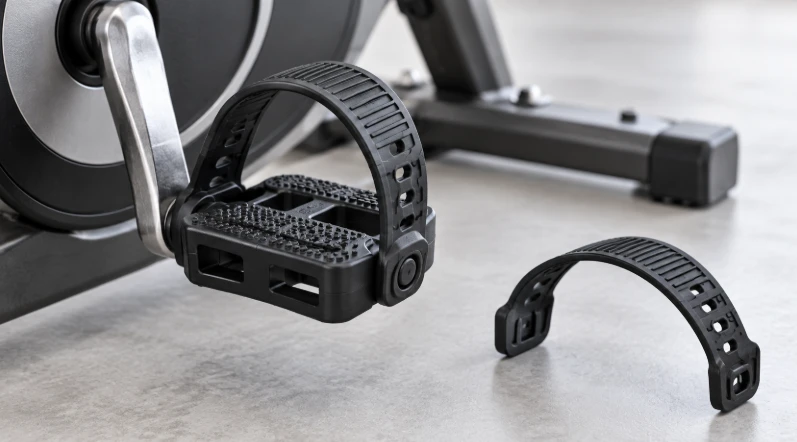
A stationary bike can become a familiar part of your daily routine, but its smallest components are easy to overlook. Pedal straps are a good example. You adjust them around your shoes, start pedaling, and rarely think about them again—until one cracks, slips, or stops fastening properly. For owners researching exercise equipment replacement parts, checking these straps is a useful place to start.
Pedal straps help keep your shoes positioned on pedals designed to use them. When a strap no longer holds its adjustment, you may find yourself interrupting your workout to reposition your foot. That inconvenience deserves a closer look. Before assuming the entire bike needs replacing, inspect the strap and the pedal it attaches to.
Look for visible cracks, torn adjustment holes, frayed edges, or damaged fastening points. Compare both straps, since their condition may differ. A strap that looks intact but repeatedly comes loose also needs attention. Stop using a damaged component and consult your bike’s instructions to determine the appropriate replacement.
Choosing a replacement begins with identifying your equipment. Record the brand and exact model number, then check the manufacturer’s parts diagram or replacement catalog. A product photograph alone may not reveal whether a strap will fit. Schwinn’s replacement-parts guidance, for example, directs owners to identify the equipment and locate the needed component before ordering.
Next, examine how the existing strap attaches. Compare its fastening arrangement, width, length, and adjustment holes with the replacement listing. Treat the word “universal” as a reason to verify compatibility carefully. If the listing does not explain how the strap connects to your pedal, ask the supplier before purchasing.
Comfort also matters when assessing fit. The replacement should accommodate the shoes you normally wear while allowing the adjustment described in your equipment manual. A strap that barely reaches its fastening point may leave little room for adjustment. Likewise, extra length is only useful if the strap can be secured properly without interfering with the pedal’s movement.
Inspect the pedal itself before placing an order. If the strap’s attachment point is broken, replacing the strap alone may not resolve the problem. A cracked pedal body or damaged fastening mechanism calls for a different repair. Identifying the full extent of the damage helps you avoid buying a small part when the surrounding assembly also needs attention.
When the replacement arrives, follow the instructions for your specific bike and pedal design. Keep the bike stationary while working, and check that each attachment is fully seated before use. Avoid forcing an unfamiliar fastening system into place. The owner’s manual is the appropriate reference for model-specific assembly, operation, and troubleshooting guidance.
After installation, check the fit with your usual workout shoes and follow the manual’s procedure for confirming proper adjustment. Pay attention to slipping, unexpected movement, or discomfort. Make strap inspection part of your equipment maintenance routine, especially if several people share the bike and regularly change the settings.
Replacement stationary bike pedal straps may be a modest purchase, but finding the correct pair requires more than matching their appearance. Start with the bike’s model, verify the attachment design, and inspect the surrounding pedal. Those simple steps can help you make a targeted repair and keep a useful piece of exercise equipment in service.